April 23, 2018
Guest Blog – Taking Refuge: Sannidhi and Sharanagati in Lived Experience by Nalini Garciarena
Reflections on the Retreat in Dharamshala, November 2025
Between Doubt and Opportunity
I really wrestled with the idea of going to Dharamshala at first. The political and territorial uncertainty in the Kashmir region was weighing on me, and I was not sure if it was the right time to be heading that way. However, the situation stayed calm, so I finally decided to buy the ticket and wait.
Before I fully committed, I sat down with my mother and a close friend. They both saw things the same way: if you have the resources, the heart for it, and the time, you have to take the chance. My mother was especially insistent. She reminded me that travelling while you are young and your body is resilient is a completely different experience from trying to do it when you are older. I eventually just asked myself, “What else do I have to do that is so important?” The answer was, “nothing.” I did not want to look back with that specific kind of regret. Opportunities like this are rare. We either take them or leave them. And so, I found myself organising my trip to Dharamshala.
The journey felt so much longer this time than it did back in January 2025, when I had gone for the Tiruvannamalai retreat. I think it was the sheer distance; travelling all the way from Argentina was a completely different ball game compared to my last trip, where I was already settled in India and just moving from Rishikesh to Tiruvannamalai. I did not exactly start this leg of the trip on a high note. I left my mother’s house feeling physically drained, dealing with digestive issues that would not quit. When you feel that low, your mind starts to play tricks on you. I found myself spiralling into doubts: “Why am I doing this? Why such a long trip? Maybe I should have just waited for the February 2026 retreat in Tiruvannamalai.” I kept questioning the point of all this effort, wondering if I could even sustain it. Those thoughts were circling in my head and honestly making me feel worse than the physical discomfort did.
But I was already moving. I had two days of travel and four different flights ahead of me, so there was no turning back. I finally reached McLeod Ganj around noon on November 4th and checked into a hotel right in the centre of town. The very first thing I did was retire into bed. I did not even touch my suitcases. There is something so restorative about deep sleep, and it was exactly what I needed. When I finally woke up, the world felt a bit brighter. I organised my things and stepped out for a walk to visit His Holiness The Dalai Lama’s Temple and find something to eat at a nearby restaurant. By the time I sat down, I felt a wave of relief and genuine cheer. I just thought to myself: “How great that I actually came!”
The next day, Sandeep (a friend I had met along with Sudha back in Tiruvannamalai in January 2025) sent me a message. He told me it was Kartik Purnima, a day considered deeply favourable for walking under the full moon. In the Hindu tradition, there is a belief that doing so brings spiritual benefits. So, I went out and walked under the moonlight, alone in a place that was still entirely new to me. I felt a sense of serenity and calm. It felt like a beautiful, auspicious way to begin the retreat in just a few days. This would be my second retreat with Gautam, and I could not help but wonder what sensations or thoughts might surface this time. There is something unique about hearing his teachings in person, and I was curious to see how it felt to be back in his presence.
Encounters with the Truth: Reflections in the Satsangs
The retreat finally began on November 7th. That morning, I spotted Gautam at breakfast. He was sitting with two ladies, and the hall was otherwise empty. I went over to greet him, and he invited me to join them. We chatted for a bit, and I felt such a deep sense of joy just being there. I could not help but think: “How good that I came” or perhaps, “how good that God brought me here.”
Over the three days of the retreat, Gautam spoke about ‘love, trust, and surrender’ and how they are all deeply interwoven. He explained that true love is not actually an emotion, because it does not shift with external situations or temporary moods. Instead, it is a state of consciousness that remains constant and unconditional. The love he refers to is the very nature of our existence, of being itself. It is the energy that flows through everything, uniting it all into a single whole. This kind of love transcends personal relationships because, in a deeper sense, there are no ‘others.’ Everything is just a manifestation of the same Consciousness. Gautam shared a beautiful thought from Ramesh Balsekar to drive it home: “Love everyone as if you had created them.”
Gautam also suggests that where there is love, there is naturally trust. This is not the kind of trust we usually talk about; it is a trust that grows from a deep acceptance that there is no real separation between the ‘I’ and the ‘other.’ It comes from seeing that everything, including every event in our lives, is a manifestation of universal Consciousness. This trust does not depend on what we do or what others do. Instead, true trust is born from recognising that everything is interdependent. It is all part of a cosmic dance that the ego simply cannot control. We are not the ones ‘doing’ any of this; everything is the Will of the Divine, of Brahman, and everything happens as an expression of that transcendental Reality.
When you look at the world this way, there is nothing outside of that Consciousness to fear. Everything that is, everything that has been, and everything that will ever be belongs to one single reality. Once you recognise this, fear starts to dissolve. There is nothing separate from the Divine, so whatever happens (no matter what it is) is simply part of that same Unity.
Yielding Without Resistance
Gautam points out that along with love and trust, there is surrender. He describes it as a triangle where each vertex represents one of these components; if any of the three is missing, the whole structure collapses.
The surrender he refers to is a yielding to the natural flow of life and an acceptance of what is. It is about embracing unity in every moment without resisting what happens. It is a deep act of trust: knowing we do not need anything beyond what is given to us, or rather, acknowledging that we have no real control. Surrender arises naturally when love and trust are present. Thinking we have control over anything is exactly what keeps us distanced from our true nature. By surrendering, we merge into that Unity and let ourselves be carried by the course of life. As Gautam says, surrender is not an action; I cannot say “I surrender,” because it is actually a state of being.
He also introduced two specific terms: Sannidhi (Divine proximity) and Sharanagati (surrender). He explained that when everything in life is seen through the light of the Teaching (when there is a lived understanding that there is no separation and that everything is a manifestation of universal Consciousness) love emerges. Gautam says that when we begin to live in the light of these divine teachings, Sannidhi has occurred.
Sometimes, the image of the Guru might even appear in our minds. In a difficult moment, we might ask ourselves, “What would the Master do here? How would he behave?” These are indicators of how close we are to the teachings in our day-to- day lives. In Sannidhi, trust is reinforced because closeness to the Truth dissolves our doubts. It allows us to see that we are not the doers, but simply instruments of the Divine Will. This trust, in turn, gives rise to total surrender, or Sharanagati.
Gautam also speaks of its meaning as ‘taking refuge’ in the Divine Will. It is a surrender rooted in acceptance and trust in life exactly as it is. It happens when we truly grasp that there is nothing that is not part of the Divine; we become aware of our own fragility and our dependence on that divinity for protection, guidance, and spiritual liberation. It is the act of completely surrendering to Divine grace, without reservations or expectations, leaving behind the need for personal control and the ego. According to Gautam, it is a form of surrender without resistance: a deep acceptance of what life offers, trusting that everything is part of a larger plan. It is a state of deep humility. I remember Gautam saying, “Helplessness brings humility,” which perfectly captures that recognition of our vulnerability. We realise we cannot control everything, but by surrendering with faith, we align ourselves with the universal Will.
Sharanagati becomes the culmination of trust. It is that moment when, recognising we are one with the Divine, we surrender completely and without fear. ‘Love, trust, and surrender’ finally merge into a single act: the act of being one with the Divine. Love is the flow, trust is the process of yielding to that flow, and surrender is the falling away of the belief in the individual ‘I.’
Gautam also speaks of a “total comprehension.” I looked into what that truly implies and found it refers to a state of deep, complete understanding, without doubts or reservations. It is a space where new perspectives open up and the limitations of the common mind simply dissipate. It is about grasping the essence (in this case, the realisation that everything is the Will of God, that no one is the author of their actions, and that there is a total acceptance of what is). Gautam says that this comprehension can actually become a life mantra.
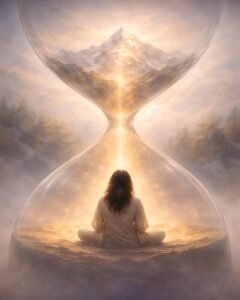
For me, the satsang sessions and the meditations are always moments of discovery. They offer a space to reach new understandings or to reinforce what I have already learned, often seeing things from a completely fresh perspective. Gautam has a way of imparting these teachings through examples, stories, and anecdotes, but also through silence: a silence that I find incredibly powerful and profound. The teaching itself is simple. I feel that, little by little, it is starting to settle within me, much like the sand falling through an hourglass.
Perhaps it is only a matter of time, or perhaps time has nothing to do with it at all. One of the other participants mentioned to me, “Gautam is a good communicator.” I think it goes deeper than that; I believe he has the gift of both speech and silence.
Sharing the Journey: Encounters and Learnings
The retreat recordings on the official YouTube channel of Gautam, are of great quality but it was a bit disappointing that the audio recordings made by me did not turn out well. The sound was just too low to catch everything. I always record the sessions because I love listening back to them; I usually discover something new that I had not quite grasped in the moment. But to my surprise, in some of the clips, the only thing you can hear clearly is the laughter of the participants. It turns out those recordings captured some of the funniest, lightest moments instead.
This time around, there were two people from Chile in the group. Having them there made me feel a bit more at ease, likely just because of the shared language and the familiarity of home. The group was smaller than the one in Tiruvannamalai and mostly made up of people from India. At times, I felt a slight twinge of discomfort, watching how effortlessly they moved within their own culture and beliefs, while I felt a bit like a ‘foreigner’ looking in. But I know that is part of the journey; I am the one travelling in their land, and it is up to me to adapt and integrate.
That cultural contrast also brought back something my yoga teacher once told me: “It is not very well regarded for a woman to travel alone to India.” For a long time, I let fear hold me back. Overcoming that was a real challenge, but by taking a few precautions and just starting the journey, I have learned so much (mostly how to find strength in my own independence).
Despite those moments where I felt a bit distant, Gautam was always so warm and considerate toward everyone. He makes himself available not just during the formal satsangs, but also during walks or evening gatherings. I remember him asking Juan about the well-being of the other Chilean participant, showing genuine concern. That attentive, loving attitude was a constant reminder that the atmosphere Gautam creates is always rooted in inclusion and care, even when the group dynamics felt a bit closed to me. I ended up buying a few books and an oracle deck conceived by Santosh Sachdeva, based on her Kundalini Journey, called The Great Kundalini Journey Wisdom Deck. The cards were beautiful, filled with meaningful phrases and lovely drawings. I used them three times up until now: once during the retreat, once before leaving India, and again when I got back home. I just felt open to receiving whatever message aligned with what I was going through. The first card I drew was ‘Synchronicity.’ It said, “In the connection of encounters with others, we receive a blessing that transforms into an invitation to connect more deeply with ourselves and with the universe.” It really made me pause and think about the ‘other’ and how, ultimately, every relationship is just a reflection of my relationship with myself and with God. Drawing that card felt like a true sign.
The day after the retreat ended, we all went to see His Holiness The Dalai Lama. It was an experience I never imagined I would actually have. Even though I do not have a direct connection to Buddhist philosophy or a specific devotion to him, I have so much respect for his presence. He carries such a message of love, compassion, and wisdom. The encounter was brief, but it felt like a great blessing.
After the visit, we returned to Udechee Huts, which was the venue of the retreat. Some of the others began to head home, and our group started to shrink. That afternoon, I had lunch with Mio on the terrace. Even though there were other people around, our conversation unfolded in a really special way. I had met him at the previous retreat, but this time we clicked on a much deeper level. We started talking about family constellations. We touched upon fears and my own struggle with surrender. I shared something very personal with him: this feeling that I do not always flow completely with life. It is as if I have built walls around myself; I felt like a ‘fish out of water.’ Those walls were likely born out of a need for protection, survival strategies shaped by years of conditioning and perhaps staying too long in my comfort zone.
On the last day of the retreat, Gautam had spoken about how fear and trust are two sides of the same coin. He told us not to run from our fears, but to face them and ask where they truly come from. Even though I know you cannot force these things, the idea came up to do a constellation exercise with Mio right there. Mio represented Gautam (as a symbol of life itself) and I represented myself. The instruction was simple but challenging: just observe the body, the sensations, and the emotions, without letting the rational mind take over. We were holding hands, which felt like a powerful symbol of connection. I stood there in front of him, but I found myself completely unable to move forward. Mio just calmly told me there was no hurry; he was there, and I should only take the step when I felt I could.
I realised that this stillness was fear, but I had to ask: fear of what? It felt like the fear of leaving my comfort zone, as if staying still was my way of refusing to move toward the unknown. In that moment, my movement was not forward yet; it was inward. I understood that something inside me needed to find its place first; it needed to settle and ground itself. After a long while, I finally managed to take that step forward, and we ended the exercise with a hug. It was a gesture that felt like saying “yes” to life, to the bond, and most importantly, to my own timing.
In constellations, authentic movement usually only happens after you honour your own resistance, and what comes slowly, when you respect the timing, is what tends to stay with you. In that exercise, Gautam (as life itself) felt like a vast, loving presence that was not pushing or demanding anything. He was just waiting. That silent presence showed me there was nothing I had to prove. The movement did not belong to the force waiting for me; it belonged to me. I had to take my own place and take the step when I was truly ready. Working with Mio helped me recognise the fears and the walls I have built to protect myself. What came up does not need to be solved overnight. It just needs to be observed with patience, so that whenever the next movement comes, it is authentic.
My Last Days in India
Those days at the retreat helped me realise my own fragility and vulnerability, but it made me wonder: vulnerability to what? I think it is a vulnerability to the emotions and thoughts that surface, and to the conditioning that shapes the constant back and forth of my life. I notice now that I am much more aware of my fears, my doubts, and my insecurities. Writing helps me with this; it has become a kind of therapy. This fragility actually helps me connect with myself and others in a more loving way. It is as if I am learning to accept myself so that I can truly accept others and everything that happens.
November 11th was my last day at Udechee. I woke up early and headed up to the terrace. The sun was just beginning to softly light up the mountains, and I sat there for a while, just taking it in. After breakfast, Gautam said goodbye to the few of us remaining. I thanked him for his teachings and his presence, wished him a happy birthday in advance, and we shared a hug.
Meaningful hugs are such a beautiful way to connect. I remember hearing that they are special because our heart is on the left side, leaving the right side empty. When we hug someone, our hearts meet, and for a moment, it feels like we have two hearts (one on each side). It is a perfect way of giving and receiving, of simply being one.
I spent two more days in McLeod Ganj, trying to keep my mind quiet, though it was still full of images, impressions, and sensations from the retreat. I walked, visited the Temple, and rested. Eventually, I made it to Delhi, my last stop in India. There, I drew another card from the deck. It said: ‘Blessings.’ I whispered a deep thank you out loud. On November 15th, I finally returned home. The last card I drew was ‘Connection.’ It said: “Do not seek approval or validation from the outside. Turn inward, because there you will find the answers. Connect with your Higher Self, and He will show you the way.” That was the message I was meant to keep.
Soon, in February 2026, I will return once again to my beloved India for another retreat with Gautam. I will be there for two weeks, arriving with no expectations, because I know every encounter is different. I truly hope that Gautam will be able to visit Chile this year and share his divine teachings on this side of the world.
For any feedback/comments, please write to Nalini at nalinigarciarena@gmail.com
Read :
 Nothing and the Centaur
- Guest Blog – Arunachala Girivalam by Vikrant Rawa
March 8, 2024
- Guest Blog – The Light of the Guru by Priya Tandon
October 1, 2024
- On The Occasion of Guru Purnima 2025
July 28, 2025
- Guest Blog – On Guru Tattva by Soojata Relle
August 14, 2026
- The End of Duality
September 20, 2020
- Advaita and the Energy Body
September 14, 2020
- True Apperception
April 25, 2019
- The World’s Best Astrologer
September 7, 2018
- Nisargadatta and the funeral of death
September 3, 2018
- Ramesh Balsekar – Destiny’s child is 90
May 3, 2018